Aleta Pippin in her studio(Published September 2015) Painter and Pippin Contemporary founder Aleta Pippin has followed an artistic journey of continuous exploration through various media, styles, and color palettes. From luminescent oil paintings to acrylic abstract landscapes, from poured paintings to LED lit panels, Pippin’s constant experimentation keeps her work fresh and exciting to viewers and collectors. For this show however, Pippin is revisiting her original passion for creating vibrant, abstract oil paintings, and plans to bring that energy and emotional resonance into her future artistic endeavors.

Back to the Future: The Art of Exploration opens September 23rd with an artist reception on Friday, September 25th from 5-7pm. Vivid blues, glowing yellows, and joyful pinks fill the gallery with light and evoke a feeling of happiness from the viewer. Some paintings take on a more spiritual and thought-provoking theme, while others, such as Caribbean Play, are simply about Pippin’s use of color and the emotions each tone can trigger.

Aleta Pippin Paintings at Pippin Contemporary

Caribbean Play (left) and Magical Mystery Tour hanging at Pippin Contemporary.

“The reason I continue to pursue color and light in my work is because I believe it has a positive impact on people,” explains Pippin. “My goal is to create art that when people look at it, it joyfully inspires them.”

Bloom Where You're Planted by Aleta Pippin at Pippin Contemporary

Bloom Where You’re Planted, 16×16″ oil/panel.

Pieces like Reaching Deeper, Garden’s Gate, and Bloom Where You’re Planted still burst with color, but the titles allow for a deeper perspective. According to Pippin, these paintings are about connecting with your inner self and looking past the obvious.

“Bloom Where You’re Planted is all about being present where you are in life,” explains Pippin. “People are always saying, when I do this or when I get that – then I’ll be happy. But all those things are outside of ourselves. All of us can make the best of where we are at any given moment.”     

Garden’s Gate takes on a similar theme of looking beneath the obvious. It was inspired by the story of The Secret Garden, a book Pippin loved as a child and continues to read often as an adult.

Garden's Gate painting by Santa Fe artist, Aleta Pippin

Garden’s Gate, oil on canvas, 40″ x 40″

“I think the first time I read The Secret Garden may have been in the fourth grade. I loved it then. On the surface, it’s a “feel-good” story. However after reading it several times as an adult, I’ve discovered many nuggets that can be applied to everyday life challenges.”

Once Again by Aleta Pippin at Pippin Contemporary

Once Again, oil on panel, 16″ x 16″

Pippin is constantly making new discoveries through her art that lead to exciting career opportunities as well as deeper self-exploration. With painting as her third career, the journey is never ending as new passions are pursued. Once Again is a small panel bursting with energy that speaks to this theme.

“You always have new opportunities to show yourself. For me, being an artist is a life journey as well as an interior journey.”

Art Adds Sizzle
Aleta Pippin painting in collectors home

Aleta Pippin’s The Ripple Effect in a collector’s home.

(Published July 2015) You’ve just looked around your home and realize there’s something missing, something that has the power to make your décor pop. We’re talking about art. The right pieces will literally move your décor from “okay” to fantastic. So, how do you begin? Where do you look for the “right” pieces? And just exactly what are the “right” pieces anyway?

If you’re like many people, purchasing art can prove a bit overwhelming. Here are some tips to guide you, as you search out that perfect piece(s) of art, the one that will give your home that “drop dead” gorgeous look.

First, there are a few myths that need to be debunked.

Myth 1: Art should match your sofa.

Great art looks good anywhere. It doesn’t have to match your sofa. Of course if you’re getting ready to purchase a piece to be placed in a certain area, you may want to consider the color and find a piece that enhances it. However, don’t make your purchasing decision based solely on such strict criteria. Remember, if you do purchase an original piece of art, it will stay with you long after the sofa has changed, the walls have been repainted, and you’ve even relocated two or three times.

Myth 2: Original art is a good investment.

Cody Hooper’s Summer Song handing in a collector’s home in Texas.

It seems to be a common line in many galleries, to tell potential buyers that purchasing an original piece from an up and coming artist is a great investment. They’ll tell you that the artist’s prices have risen steadily over the years or that the artist is just on the brink of making it big. All of that may be true. However, unless you know people who are interested in purchasing art, you will not be able to resell your investment piece and make a profit. The only people who really make a killing in the art market are those who purchased Picasso 50 years ago.

The best reason to purchase an original piece is because you love it. I have several original pieces from other artists in my home, which were purchased because I loved them. (And yes, they are up and coming artists whose prices have risen steadily over time.)

To say that you should love a piece is not an understatement. Art should evoke an emotional response. That response may be from the color, composition, or even something intangible like reminding you of a poignant happening in your life.

Cody Hooper

Cody Hooper’s Distant Drums in a collector’s dining room.

Myth 3: My child could have painted that abstract piece.

Yes, children paint wonderful pieces, but to suggest that a child can produce some of the beautiful abstract work that is in the market is dismissing artists’ creativity too quickly. Actually, most abstract artists learn to draw and to paint representational work before they evolved to abstract work. All good art conforms to guidelines of line, shape, form, atmosphere, design, and rhythm. Each artist finds their voice, much the same as a writer, and that voice may express in paint, sculpture, stained glass and on and on. And in each of those categories, there is a myriad of expressions limited only by the artist’s imagination.

You’re Ready to Purchase

Before you go shopping, stop and consider a couple of things – Do you want to purchase an original piece of art or a retail piece and how much money are you willing to spend?

Originals vs. Reproductions

There are inexpensive reproductions found in department stores, flea markets, even retail outlets in the malls. These paintings are fairly inexpensive in the $75-$400 price range.

Giclees have been extremely popular. A giclee is a computerized reproduction of an original piece that is usually “printed” on canvas. Some artists, or their employees, paint into this reproduction, giving it the texture and look of an original piece. Usually these pieces are numbered in the lower corner, like any reproduction, so there’s no question in the buyer’s mind.

Giclees are good buys if you’d like to have a piece that looks like an original, at a lower cost. It’s also a way of collecting the work of an artist you like, but an original is out of your chosen price range. (Not all artists agree with mass production and will not produce giclees.)

Some artists create Limited Editions of their sold pieces. These may be printed on acrylic and affixed to an acrylic backing. They may be giclees as described in the preceding paragraph or they may be printed on some other structure. Since they are are Limited Editions of original work, they will probably be priced higher than the giclees found in department stores.

Nothing matches the beauty of an original piece of art. If you’ve decided to go that route and have designated the amount of money you’re willing to invest, you can probably find a piece. It may take a little doing but it will be worth it. Visit the Internet. Check out the local galleries. Talk to friends who have artwork you admire.

Aleta Pippin and Rick Stevens


Blue Arc by Greg Reiche

Blue Arc by Greg Reiche, commission steel and glass sculpture Blue Arc in a local New Mexico home.

What to look for in art?

Are you looking for a certain color, a certain pattern or even a certain size? If you’re purchasing an original, you should love it. If you’re purchasing art purely to finish the décor in your home, then you’ll want to find pieces that enhance the décor. There are several retail outlets that sell reproductions and prints, many already framed – Target, Hobby Lobby, Overstock.com, and Wayfair.com, just to name a few.

Why not spend a day looking at the various options. Check out artists’ websites, local galleries, as well as the retail outlets. You may decide to purchase an original after you see all of the amazing art that is available. And don’t forget the outdoor Art Festivals; these are a wonderful way to connect with an artist and to purchase an original piece.

If you choose to purchase an original, do a background check. Ask about the artist’s career, sales history, and make an intuitive assessment of the integrity of the person trying to sell the piece to you. Personally, I think original work truly adds to the quality of any environment.

Have fun with this. Take your time. The right piece will show itself. And it’s worth finding it, because art will add sizzle to your décor.

© 2002 by Aleta Pippin, abstract painter, updated July 2015. 

Edible Art Tour with Jambo's at Pippin Contemporary

(Published June 2015) Last night was ARTsmart’s Edible Art Tour on Canyon Road. Twenty-five galleries hosted Santa Fe’s top restaurants for a delicious and spirited evening of art and hors d’oeuvres. We had a great night at Pippin Contemporary with Chef Ahmed Obo from Jambo Cafe and African drum and dance group Agalu. All ticket proceeds for this event went towards arts education in local public schools – thanks for your support!

Photo Jun 13, 4 49 14 PM
Photo Jun 13, 4 50 54 PM
Photo Jun 13, 4 50 59 PM
Photo Jun 13, 4 51 12 PM
Photo Jun 13, 4 59 41 PM
Photo Jun 13, 5 00 11 PM
Photo Jun 13, 5 05 54 PM
Photo Jun 13, 5 06 43 PM
Photo Jun 13, 5 07 25 PM
Photo Jun 13, 5 08 41 PM
Photo Jun 13, 5 15 06 PM
Photo Jun 13, 5 26 02 PM
Photo Jun 13, 5 30 37 PM
Photo Jun 13, 5 33 59 PM

Photo Jun 13, 5 37 54 PM
Photo Jun 13, 6 47 28 PM

Pippin Pics 2015

(Published May 2015) This week at Pippin Contemporary we watched artists paint on Canyon Road, hung new art in the gallery, and visited with our friends from American Art Collector Magazine. Check out our week in photos and follow us on Instagram @PippinAbstractArtist for more behind-the-scenes Pippin Pics!

Cody Hooper Art at Pippin Contemporary

Cody Hooper paid us a visit on Saturday with these stunning paintings full of energy and light. We hung six new pieces in the gallery – visitors keep commenting on their depth, saying that peering into his panels is like entering another world.

Canyon Road Passport Quick Draw

Local artists lined the street on Canyon Road for the Passport to the Arts Quick Draw, where they created beautiful works of art in a short time frame. The paintings were then sold at a live auction benefiting the Santa Fe Public Schools Music Education Program.

Mode by Troy Pillow at Pippin Contemporary

New sculpture! ‘Mode’ by Troy Pillow is a contemporary stainless steel piece with kinetic elements.

American Art Collector Party

Gallery Director Ashley Wilson and Marketing Director Kelly Skeen at the Art Collector Magazine party at the beautiful La Posada. Always a great event with the Santa Fe art community..and with great hosts!

Greg Reiche at Pippin Contemporary

Greg Reiche brought several new Bloom sculptures in preparation for his upcoming show, “Into the Wind,” opening next Friday. More new pieces are on the way – and big things will be happening to our courtyard!

Mark Rothko at SFMOMA

Non-figurative. Stripped of allusion. Painting in its purest form.
Art lacking subject. Non-representational. Non-objective. Departure from reality. The true essence of art.

(Published May 2015) How do we define abstract art? How do we appreciate it, understand it? Critics, art historians, gallery owners, and artists have come up with copious explanations of abstraction, but the real beauty of abstract art is that it’s true definition and interpretation lies within the viewer. While some artists may have deeper intentions for meaning and message, abstract art is largely a style that provides freedom of interpretation.

When you see an abstract painting hanging in a gallery or museum, the dialogue between artist and canvas has long been completed. It’s now your turn as the viewer to finish the story, or start your own conversation.

“Art is an experience, not an object.” – Robert Motherwell

While abstract art leaves room for open interpretation, it is also helpful to gain an understanding of the movement in order to fully appreciate the artist’s talent and intention. Impressionists in 19th century Paris were the first to break from realism in art, incorporating the effects of light and perspective on a subject to depict an “impressionistic” view rather than a realistic one. From here, expressionist artists of the 20th century continued to dive deeper into the art of abstraction, infusing mood and emotion into their work with painterly style and intense color.

Abstract Expressionism followed as a dramatic movement that is most often associated with the birth of abstract art. Artists of this period, such as Jackson Pollock, used the paint itself as a subject as well as the their relationship with the material. Art became a reflection of the spiritual mind, subconscious ideas, and the artist’s (often very complex) emotions, all communicated through abstract compositions of expressive line and color.

Jackson Pollock at work in Long Island, New York, 1950. Photograph: David Lefranc/Kipa/Corbis

Jackson Pollock at work in Long Island, New York, 1950. Photograph: David Lefranc/Kipa/Corbis via The Guardian

Just like when it was first introduced in the 20th century, reactions to abstract art today are dramatically different from one person to the next. Abstract artists are given the challenge to connect with the viewer through pure movement and color, rather then realistically portraying a familiar scene that calls for familiar emotions. Standing in front of the same painting or sculpture, one person may be disturbed while another is intrigued. Neither viewer is wrong in their interpretation; abstract art encourages our most abstract thinking and gut feelings.

So, how do we define the abstract? Defining abstract art is nearly as open as interpreting it, but who better to ask than the artists themselves? We talked to our painters and sculptors at Pippin Contemporary to find out why they choose to work in abstract and how they would define the style. Here are some of their responses:

Aleta Pippin - interpretation of abstract art


Cody Hooper Quote

Suzanne Wallace Mears Quote

Greg Reiche Quote

Join us at Pippin Contemporary this summer as we celebrate abstraction with contemporary art exhibitions of oil, acrylic and mixed-media painting, as well as bronze, stone, steel and glass sculpture. We encourage you to share your own interpretations with us as you view art in the gallery.

Pippin Pics of the Week

(Published May 2015) A public sculpture dedication, new paintings, and excitement for our upcoming show this month. Check out our week in photos and follow us on Instagram for more Pippin Pics @PippinAbstractArt.

Aleta Pippin art at Pippin Contemporary

Aleta Pippin brought in several new paintings from her studio that we hung in the gallery. This piece is called Celebrate Color, a 60″ x 36″ oil/canvas. Come visit the gallery to see Aleta’s other new pieces!

Greg Reiche Public Sculpture

We spent Earth Day in Los Alamos for the grand opening of the new Nature Center where Greg Reiche’s sculpture was dedicated. The rain runoff from the roof cascades onto the stone, then goes into a reservoir that waters surrounding plants, while kinetic glass above it changes with light and air movement. A stunning sculpture and a beautiful Earth Day dedication ceremony.

Desert Rain by Cody Hooper at Pippin Contemporary

We love Cody Hooper’s artistic depiction of the “Desert Rain” we had this week. We’ve been sharing some paintings on Instagram from our artists that aren’t always hanging in the gallery or not yet added to the website…follow us @PippinAbstractArt for more “first look” opportunities.

Pippin Contemporary in Santa Fe New Mexico

We’re ready for Santa Fe summer – less than three weeks until our first show and then the Summer of Color begins!

(Published April 2015) This week at the gallery we’ve been rearranging sculpture, sending art to Australia, visiting local artist studios, and more. Check out our week in photos and follow us on Instagram @PippinAbstractArt for more behind-the-scenes gallery photos and previews of new work.

Aleta Pippin's Santa Fe Studio

Inside Aleta Pippin’s studio

“Inspiration exists, but it has to find you working.” – Pablo Picasso.


We paid a visit to the place where inspiration finds Aleta Pippin hard at work on a daily basis. Vibrant color and energetic paint splatters means new work is coming soon!

Pippin Contemporary at 200 Canyon Road

A sunny spring day inspired us to do some rearranging in our courtyard. Troy Pillow Re-Emergence moves with the wind in front of the gallery. More work from Troy is coming soon!

Detail of Allegro by Michael Monroe Ethridge at Pippin Contemporary

Did you know that Saturday, April 11th was Slow Art Day? Museum and gallery visitors around the world were encouraged to slow down and take a longer look at an intriguing work of art. After taking a closer look at Michael Monroe Ethridge’s Allegro, we noticed vivid color and texture we’d not noticed before.

Pose by Troy Pillow in a Collector's Home

“We both fell in love with the clean lines of the sculpture, but when we got home we struggled with where we would place it to showcase it’s beauty. I think we found the perfect place, as you can see…”

Remember the sale of Troy Pillow’s Pose in the last edition of Pippin Pics? It has made two Colorado collectors very happy and looks beautiful in their home. If you have photos of Pippin Contemporary art displayed in your home or office, we’d love to see them!

Peggy Guggenheim with Jackson Pollock

Peggy Guggenheim and Jackson Pollock in front of Mural, 1943, first floor entrance hall, 155 East 61st Street, New York, c. 1946 (Photo: George Karger © 2013 Pollock-Krasner Foundation / Artists Rights Society (ARS), New York)

“The collector is an artist in his own way, by the way he puts things together.
You can read a person’s soul from their collection.”
-Ayers Tarantino, Art and Antiques

(Published April 2015) Why collect? Collecting art is more than just buying pretty objects. As an art collector, you are an arts supporter, a part of art history, and are able to tell a story through unique acquisitions that reflect your tastes, ideas, and experiences. Whether you follow a single artist’s career, a specific genre, or have an eclectic range of work, art collecting is not something seasoned buyers of the art world take lightly. The pieces you acquire reflect your personality and distinguish your style. Collecting art becomes more than a hobby of buying beautiful things – it becomes a treasure hunt, a philosophical pursuit, an unyielding passion.

“I collect these objects to learn from them. In some moment these things are going to teach me something.
For me, this is like a library. These are my books.”
-Joes Bedia in ARTNews

As an art collector, not only are you culturally fulfilling your own world, you are making a difference in the life of an artist by becoming an instrumental part of their career. Throughout history, collectors have shaped the art world in subtle and overt ways. Modern art collector Peggy Guggenheim was influential in the career of early American expressionists Jackson Pollock, Mark Rothko, and Robert Motherwell as the first to publicly exhibit their work in her gallery. Gertrude Stein’s early support of Pablo Picasso and Henri Matisse through passionate acquisition and advocacy led them to become household names and arguably the most famous artists of the 20th century. Van Gogh, with no one to appreciate his swirling brushstrokes and vivid color, lived a life unknown; it wasn’t until the last year of his life and after his death that his work received the fame it deserved after finding it’s way into public and private collections.

“You can either buy clothes, or buy pictures.”
Gertrude Stein

Today, collecting art is seen by some as a luxury, others as a necessity. During times of economic downturn, the art market saw an all-time low, however, 2014 topped the charts as the highest year in history for art sales. This is in part due to new trends in the art world such as fairs, as well as Internet sales through sites such as Artsy and Artnet, that are broadening public engagement and attracting younger buyers. The top three art markets in the country remain as New York, Los Angeles, and our home city of Santa Fe. With 200 galleries in two square miles, Santa Fe is the most concentrated market – and the most historic. At over 400 years old, Canyon Road boasts over 100 galleries in its half-mile stretch. At Pippin Contemporary, we welcome tourists, art collectors, and art enthusiasts at the base of this iconic street.

“Santa Fe’s unique art scene can be compared to the cultural experience of an art fair, but with year-round accessibility. The density of diverse and high quality art in Santa Fe is unlike any other in the country, maybe even the world.”
-Aleta Pippin, Gallery Owner

Collectors continue to be highly influential in the always-changing art world. In Santa Fe, you as the collector keep galleries in business and contribute to the family-like feel of our close-knit art community. You give artists the opportunity to thrive through a creative career as they share their inner emotions and expressions through their work, and in turn create a portal where you see your own spiritual sentiments reflected.

“We collectors know that art communicates with us on different levels. Language and culture are no barriers.”
-Barbara Trapp, Art and Antiques

Guilloume new work

(Published April 2015) This week at Pippin Contemporary has been full of sunny spring days, sales, and new sculpture. Check out our week in photos, and find us on Instagram at @PippinAbstractArt to follow our Santa Fe gallery life on Canyon Road!

Photo Apr 01, 9 13 32 AMStephanie Paige sent us some great photos from her California studio – here she works hard on a piece from her new Zen Garden Series, using actual leaves pressed into the plaster. We’ll be showing her Zen Garden paintings this June at the gallery.

Photo Apr 03, 12 43 15 PMAre you familiar with Greg Reiche’s Bloom sculptures? He’s now added a new dimension to the kinetic glass style with a three-panel screen, the only one of it’s kind. Come check it out in the gallery, it’s been bringing in colorful light from outside as well as a few Canyon Road window shoppers.

Photo Mar 22, 12 59 43 PMSpring has sprung in Santa Fe! Beautiful blooms against adobe and turquoise architecture make Canyon Road an even more enjoyable experience for our out-of-town visitors (and locals too, of course).

Photo Mar 26, 11 59 26 AMArt close up! This detail of Stephanie Paige’s “Love” shows the cracking textural details created with dry weather and plaster. Not only does nature inspire Stephanie’s work, it dictates the physical outcome of every piece.

Processed with VSCOcam with c1 presetSOLD! “Pose” by Troy Pillow went home with a Colorado couple who fell in love with the fluid sleek sculpture. It was a beautiful day to enjoy outdoor art on Canyon Road.

Photo Mar 31, 12 53 53 PMNew sculpture is coming – Greg Reiche came by the gallery to plan a new piece for the courtyard. He said this one was going to blow everyone away…We can’t wait for the installation!

Photo Apr 03, 4 30 35 PM

We received several new sculptures from Guilloume including this wall relief, “Family Growth.”

Tribute to Kandinsky

(Published December 2014) The painting is monumental, taking up about a six by ten foot space on the museum wall; a space that now dances and swirls with brilliant color and untraceable abstraction. Straight and curved lines along with varied shapes of vivid color mingle on the canvas to create a haphazard, almost theatrical, experience. Taking in the piece, your eyes dart from side to side, top to bottom, trying to make sense of the colliding figures and colors. Finally you discover a central form, an oval, which seems to act as the eye of a compositional hurricane, surrounded by swirling color and form.

composition 7

“Composition VII,” Wassily Kandinsky, 1913

The piece is “Composition VII;” its creator, Wassily Kandinsky. It hangs on the bright white walls of the Los Angeles County Museum of Art in 1995 along with only fourteen other Kandinsky paintings, together making up the exhibition “Kandinsky: Compositions.” In front of the painting stands an awestruck Aleta Pippin, attempting to memorize the active bursts of color that seem to radiate Kandinsky’s energy.

“Though only fifteen paintings were displayed, I was thrilled that we went to see the show,” said Pippin. “Pictures of art never do justice to the real thing. Seeing Kandinsky’s paintings in person was inspiring to say the least.”

Pippin had begun painting just a few years earlier in 1992, and like Kandinsky, she started out creating representational work. Her paintings mostly consisted of portraiture, although the desire for abstraction seeped through in the blurring color that occupied the backdrops of her paintings.

Screen Shot 2014-12-16 at 12.30.19 PM

Early representational portraiture by Aleta Pippin.

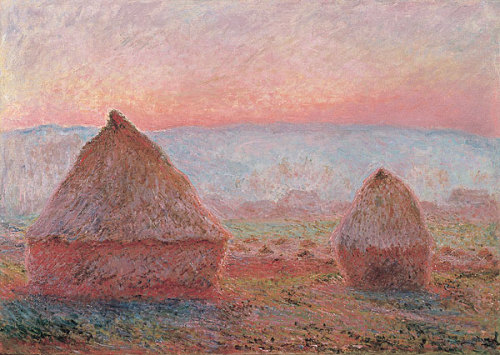
For Kandinsky, the transition into abstraction came in the early 1900s through a series of sparked inspirations, one of which was an 1896 Claude Monet exhibit in Moscow. He was astounded by “Haystacks at Giverny,” a series of Monet’s paintings depicting impressionistic haystacks in fields near Monet’s home in Giverny, France. Kandinsky later writes about his reaction to the work:

haystacks monet

“Haystacks at Giverny, the evening sun.” Claude Monet, 1888.

“It was from the catalog I learned this was a haystack. I was upset I had not recognized it. Dimly I was aware too that the object did not appear in the picture. And I noticed with surprise and confusion that the picture not only gripped me, but impressed itself ineradicably on my memory. The painting took on a fairy-tale power and splendor.”

Another push towards abstraction for the Russian artist, who is credited as being the first purely abstract painter, came from looking at his own work in a different light. One night when Kandinsky came home to his studio, he was enchanted by a painting he did not recognize. After a closer look, he realized it was his own piece lying on its side. Kandinsky recognized that subject matter lessened the impact of his paintings, and from that point on he began removing it from his work. This would eventually earn him the title of “the father of abstraction,” and “pioneer” of the Abstract Expressionist movement.

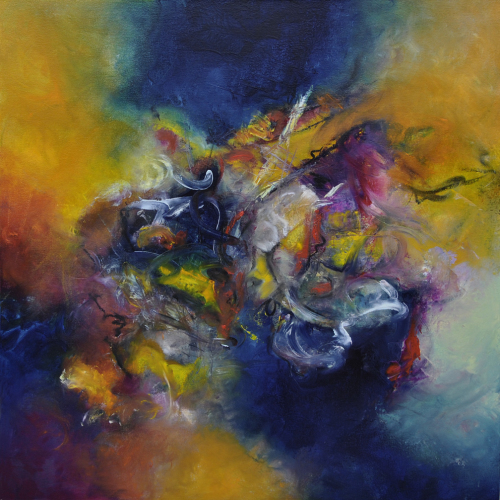
Color Abounds by Aleta Pippin at Pippin Contemporary

“Color Abounds” by Aleta Pippin, oil/canvas, 30×30″

For Aleta Pippin, the move toward abstraction resulted from a desire to experiment with imagery, color, and various media. She relates to Kandinsky’s epiphany of removing the subject matter for a more timeless and freeing composition.

“When someone views a painting containing subject matter, there is a reaction based on their relationship to that subject,” explains Pippin. “If they’re viewing an abstract painting, they have the opportunity to consider it on a deeper level, for instance, simply enjoying the color or perhaps analyzing the artist’s message.”

Kandinsky, also a renowned art theorist, took a spiritual approach to his work, analyzing the effects of color on the mind and soul. In his book, “Concerning the Spiritual in Art,” he explored his theory that color can create an “inner resonance” with the viewer by provoking a sensory experience within their soul.

Screen Shot 2014-12-16 at 12.46.43 PM

Left: “Riding the Range,” Aleta Pippin, acrylic/canvas, 36×36.” Right: “Improvisation 26,” Wassily Kandinsky, oil/canvas, 1912.

To say Kandinsky was a “colorist” is an understatement; he devoted his life to it, which is why Pippin couldn’t look away as she stood before his paintings in LACMA on that June afternoon in 1995. Her work thrives on color and has a similar spiritual bent. “I believe that true art comes from within; color is central to my individual expression,” says Pippin.

Dancing through the Seasons o-c 48x40 High Res

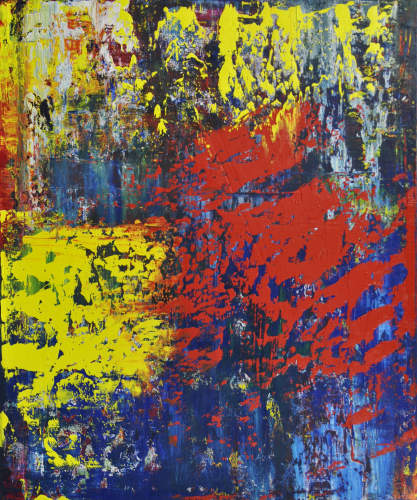
“A Tribute to Gerhard Richter..Dancing Through the Seasons,” Aleta Pippin, 48×40″ oil/canvas

The trickling effect of artists inspiring artists is how art movements are born, with creative leaders carrying the influence of master artists that came before them. For Pippin, inspiration comes from artists living and dead who appreciate a sense of color along with timeless and spiritual interpretations of abstract ideas. The visual expressions of Gerard Richter and Claude Monet have directly influenced Pippin’s paintings, and abstract expressionists like Kandinsky, Rothko, and de Kooning serve as an overall inspiration to her painting style.

With these artists as her guides, Pippin creates liberating works of art with an intuitive use of color and energetic freedom.